• 7 Sections
  • 25 Lessons
  • Lifetime
Expand all sectionsCollapse all sections
  • Module 1: Maize Description, Varieties, and Seed Selection
    Objectives: at the end of this section, the participants should be able to:
    • Have knowledge of maize, its different varieties, uses and economic importance.
    • Know TAAT technologies for maize commodity. (Pro-Vitamin A maize)
    • Differentiate between the types of maize seed. Know the high yielding varieties in the market and their sources. Specifically identify Pro-Vitamin A maize variety.
    • Knows the nutritional components of PVA maize.
    • Identify high quality seed of PVA for planting.
    5
    • 1.1
      Expected Learning Outcomes
      1 Minute
    • 1.2
      Introduction to Maize and Its Economic Importance
      4 Minutes
    • 1.3
      Maize Varieties and Seed Selection
      6 Minutes
    • 1.4
      Pro-Vitamin A (PVA) Maize
      4 Minutes
    • 1.5
      Reflection Questions
      2 Questions
  • Module 2: Land Preparation and Planting Techniques
    5
    • 2.1
      Expected Learning Outcomes
      2 Minutes
    • 2.2
      Land Preparation and Equipment
      3 Minutes
    • 2.3
      Soil Requirements and Preparation Techniques
      3 Minutes
    • 2.4
      Planting Practices
      5 Minutes
    • 2.5
      Reflection Questions
      2 Questions
  • Module 3: Farm Management and Harvesting Techniques
    6
    • 3.1
      Expected Learning Outcome
      3 Minutes
    • 3.2
      Growth requirement for Maize Plant
      4 Minutes
    • 3.3
      Agronomic Practices
      4 Minutes
    • 3.4
      Pest, Disease, and Aflatoxin Management
      4 Minutes
    • 3.5
      Harvesting Techniques
      3 Minutes
    • 3.6
      Reflection Questions
      2 Questions
  • Module 4: Post-Harvest Handling, Storage, and Packaging
    5
    • 4.1
      Expected Learning Outcome
      2 Minutes
    • 4.2
      Post-Harvest Processing
      3 Minutes
    • 4.3
      Storage Technologies
      6 Minutes
    • 4.4
      Packaging and Transport
      2 Minutes
    • 4.5
      Reflection Questions
      2 Questions
  • Module 5: Maize Processing and Value Addition
    5
    • 5.1
      Expected Learning Outcome
      4 Minutes
    • 5.2
      Industrial and Traditional Maize Products
      3 Minutes
    • 5.3
      Value Addition and Quality Control
      3 Minutes
    • 5.4
      Branding and Market Positioning
      3 Minutes
    • 5.5
      Reflection Questions
      2 Questions
  • Module 6: Agribusiness and Enterprise Creation in the Maize Value Chain
    5
    • 6.1
      Expected Learning Outcomes
      3 Minutes
    • 6.2
      Identifying Business Opportunities in the Maize Value Chain
      3 Minutes
    • 6.3
      Feasibility Studies and Business Planning
      2 Minutes
    • 6.4
      Finance, Market Linkages, and Economic Analysis
      3 Minutes
    • 6.5
      Reflection Questions
      2 Questions
  • Final Assessment and Certification
    2
    • 7.1
      Mini Project
      1 Question
    • 7.2
      Final Quiz
      30 Minutes15 Questions

The Maize Value Chain: From Production to Market

Curriculum

Introduction to Maize and Its Economic Importance


Overview of Maize
Maize (Zea mays), commonly known as corn, is one of the most essential cereal crops worldwide due to its versatility, adaptability, and productivity. Originally domesticated in Mexico, maize spread globally and adapted to diverse climates, from tropical to temperate regions. Today, maize supports over 300 million people in sub-Saharan Africa as a staple food crop, providing calories, essential nutrients, and a basis for various economic activities.

Maize is cultivated in over 164 million hectares globally, with production reaching over 1 billion tons annually. Key production regions include the Americas, Asia, and sub-Saharan Africa, where maize is fundamental to both food security and economic stability.
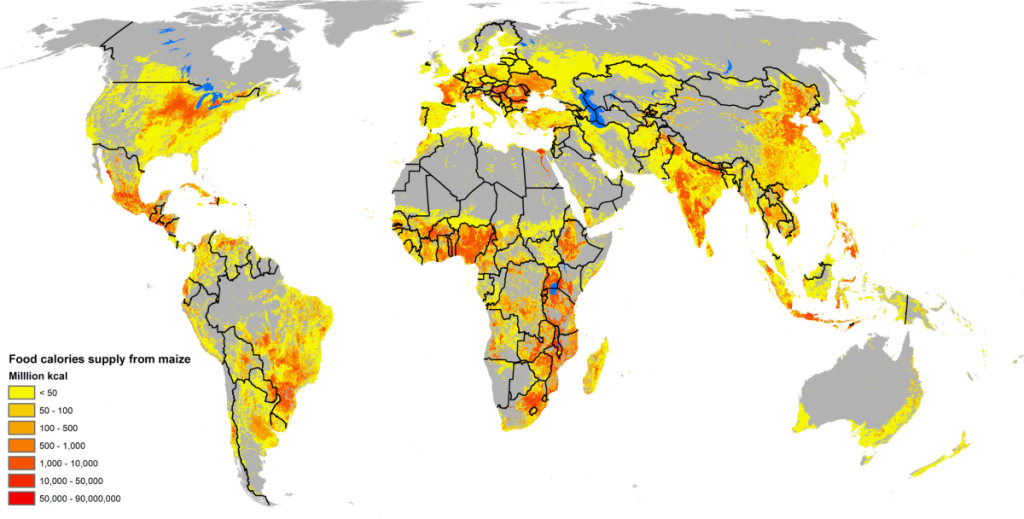
Map of global maize production regions.

Major uses of Maize

Maize has numerous applications both domestic and industrial. These include:

Cooking Oil, Corn Starch, Dextrose, Dextrins, Corn Syrup, animal feed production etc

Economic Impact of Maize in Africa
As a primary staple food in sub-Saharan Africa, maize plays a significant role in food security, poverty reduction, and income generation. It accounts for 30-50% of food expenditure in low-income African households and supplies over 30% of caloric intake. Its role in smallholder livelihoods is crucial, providing food, feed for livestock, and cash from market sales. Maize-based products, including cooking oil, starch, and animal feed, further expand its economic value. African countries increasingly focus on enhancing maize production to ensure food security and economic growth.

Prev Previous Expected Learning Outcomes
Next Maize Varieties and Seed Selection Next

Login with your site account

Lost your password?

Not a member yet? Register now

Register a new account

Are you a member? Login now